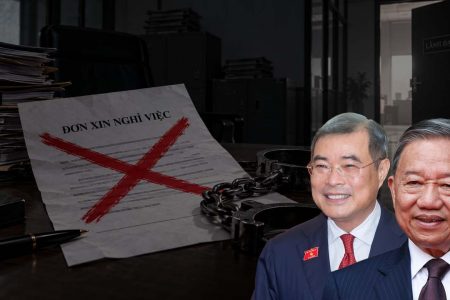
At the trial for a major corruption case involving the Ministry of Health, the public once again witnessed a rare “reversal of fortune.” Former Minister of Health Nguyen Thi Kim Tien fulfilled her obligations and paid restitution totaling more than 109 billion VND, equivalent to 4.1 million USD.
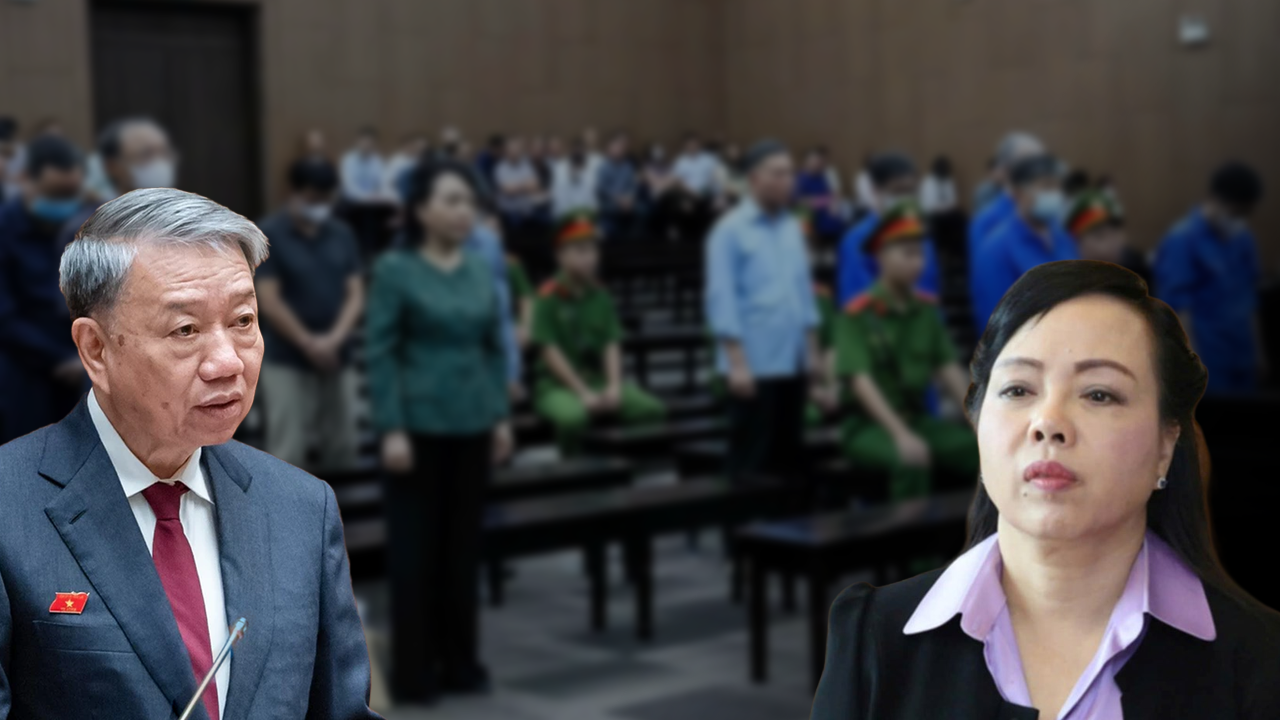
These figures immediately raise a simple calculation and a question: with a minister’s base salary of approximately 25 million VND per month, it would take an official nearly 300 years of “not eating” or spending anything to save up the aforementioned 109 billion VND.
The vast disparity between official income and the “staggering” financial resources revealed in court has long been a common phenomenon in major corruption cases in Vietnam.
However, the common explanations—such as claiming these are “assets accumulated by the extended family,” “income from selling brooms,” or “a lifetime of savings”—only further expose the absurdity in the court records.
Meanwhile, in these cases, authorities have determined that there were numerous meetings and excessive favoritism toward the winning bidders in nearly all key projects.
When public power is traded, the price paid is not only the loss of trillions of dong in public funds, but also delayed hospital construction, wasted resources, and the infringement of the rights of millions of patients.
More concerning is that the mechanism for “voluntary remediation of consequences” resulting from corruption is gradually being distorted into a procedural advantage for powerful leaders with the money to buy leniency.
Although the law stipulates that compensation for damages is a mitigating factor in sentencing, the fact that a massive sum of money can be so easily raised in exchange for leniency has led the public to question the equality of justice.
The public is asking whether the current practice of returning funds is becoming a “lifeline” that helps high-ranking officials who have violated the law reduce their criminal liability for the immense damages they have caused.
This reality highlights a major gap in the mindset of state governance, as paying restitution only addresses the symptoms—that is, recovering the embezzled funds—but does nothing to mitigate the dangerous nature of the corrupt acts themselves.
If a high-ranking official can rest assured that they have sufficient financial resources to “make amends,” the deterrent effect of the law will be severely diminished. This would make the line between genuine repentance and mere pretense extremely tenuous.
Moreover, the greatest paradox lies in the management and declaration of assets. Why is it that the Communist Party of Vietnam’s oversight system—complete with comprehensive regulations requiring annual asset declarations—can only uncover illicit assets after a case has already been adjudicated by the court?
This reflects that the mechanisms for controlling power and ensuring asset transparency among officials still have many loopholes. Current asset declarations remain largely procedural, lack an independent verification mechanism, and do not yet serve as an effective control tool.
Transparency cannot exist solely on paper in resolutions; it must be measured by the effectiveness of asset oversight of leaders in practice.
Corruption cannot be curbed merely through belated sentences aimed at remedying the consequences or by leaders voluntarily returning “stolen” money in court.
The public recognizes that remedying the consequences is a mandatory obligation to recover assets for the state, but it absolutely cannot become a tool for legally trading leniency.
Only when power is subject to transparent, fair oversight and accountability mechanisms will the farce of “turning nothing into something” cease to have a foothold.
Trà My – Thoibao.de